


Truck and Boat Fuel-Saving Tips: More MPG, Less GPH


Whether fuel prices are rising, falling, or simply refusing to sit still, using less fuel is always a smart move. The truck and boat fuel-saving tips below can help you squeeze more MPG from your tow vehicle, reduce GPH on the water, and keep more money available for the part of boating you actually enjoy.
Truck and Boat Fuel Saving Tips for Better MPG and Less GPH:
1. Check Your Air Filter and Intake System:
A restricted air filter, dirty throttle body, or clogged intake path can make both trucks and outboards feel lazy, even if the fuel savings are not always dramatic on modern computer-controlled engines. On newer fuel-injected trucks, a clean air filter may help restore performance more than MPG, but airflow still matters. If the engine has to breathe through a straw, it is not going to be happy — and neither is your fuel credit card bill.
I am a big fan of the K&N filters that I can clean and reinstall for this reason... Also, dirty throttle bodies (Truck and Boat) can cause issues with higher than expected or jumping idle speeds and an air restriction into the engine, which is just as bad. Need an example of restricted Air Flow and Power output. Go jogging with your hand over your mouth and see the extra effort it takes?
2. Straighten Out the Tow Vehicle and Trailer:
Improper alignment can cause your engine to exert more effort, decreasing fuel efficiency by up to 10%. Correcting this issue is akin to saving 28 cents per gallon and simultaneously reducing expensive tire wear. Additionally, when was the last time you checked the wear pattern on your boat trailer tires? It's possible that the axle(s) may not be properly aligned, causing similar effects. Furthermore, upgrading to radial tires on your boat trailer if they do not have them now, can enhance fuel efficiency. A friend of mine experienced significant fuel savings on a trip to The Keys and back after installing radial tires on his trailer, thanks to their lower rolling resistance.
3. Keep Up With Basic Engine Maintenance:
A well-tuned engine can boost mileage by 4 percent, equating to a savings of about 11 cents per gallon. While the term "Tune-Up" may seem outdated in the era of fuel-injected, computer-controlled engines, the effect of worn spark plugs and other related ignition items remains significant.
Examining other ignition components like plug wires, distributor caps — though they are becoming rare these days — and loose or dirty ground wires is important. These issues can decrease performance and increase fuel consumption.
4. Pump them up:
For tires, DOE/AFDC notes that keeping tires properly inflated can improve mileage by about 0.6% on average and up to 3% in some cases, while under-inflation can reduce mileage by about 0.2% for every 1 psi drop across all four tires.
It is reported that more than one-quarter of vehicles have improperly inflated tires. The average under-inflation of 7.5 pounds costs drivers around 8 cents a gallon of gas. This also applies to your boat trailer tires, and if you need a reminder, let out about 20 psi of air from your bicycle tires, and then go take a ride!
5. Check your fuel cap:
It's estimated that one in six cars on the road has broken or missing gas caps, which reduces gas mileage and could harm the environment. Fix it and save and estimated 2 cents per gallon.
6. Lose weight:
For every 100 extra pounds carried around, your vehicle loses 1-2 percent in fuel efficiency or roughly 4 cents per gallon. This figure does not apply as much, or as quickly, to your pickup or SUV as it would a car since they are geared lower. But, once you get into the 200 to 500 extra pounds range, it can... Also, covering up the truck's bed to clean up the airflow (mostly at 35 mph and higher) can return a reported saving of 5 to 15% and pay for the installation of the cover over time.
Just don't tell your Spouse, "Dave says you have to stay home so I can save on fuel," I am not taking the fall for that one! 😊
7. Don't speed:
DOE also says fuel economy drops quickly above 50 mph, and every 5 mph over 50 can feel like paying more per gallon. For every five mph you reduce your highway speed, you can slash fuel consumption by an impressive 7 percent. Just ease off from 70 mph to 65, and you’ll save about 19 cents per gallon. Even when towing, especially in flat areas like Florida, driving under 70 mph allowed my Xterra to pull the Skiff smoothly in overdrive, unless I hit a grade or need to pass.
When towing, my fuel efficiency only dropped from around 20 mpg to about 18/17 mpg, despite hauling an extra ton behind me. Let’s face it, most SUVs and Trucks are about as aerodynamic as a brick, and the only way I’d ever outrun a Porsche or BMW is on a golf course! So, in my opinion, it is both foolish and unsafe (even though my SUV can handle it) to try and push much past 70 mph while towing a boat. Plus, it’s all too easy to lose control if you’re not careful.
So, slow down and stop trying to run like it’s the "24 Hours of Daytona" every day. You’ll save money and stress at the same time!
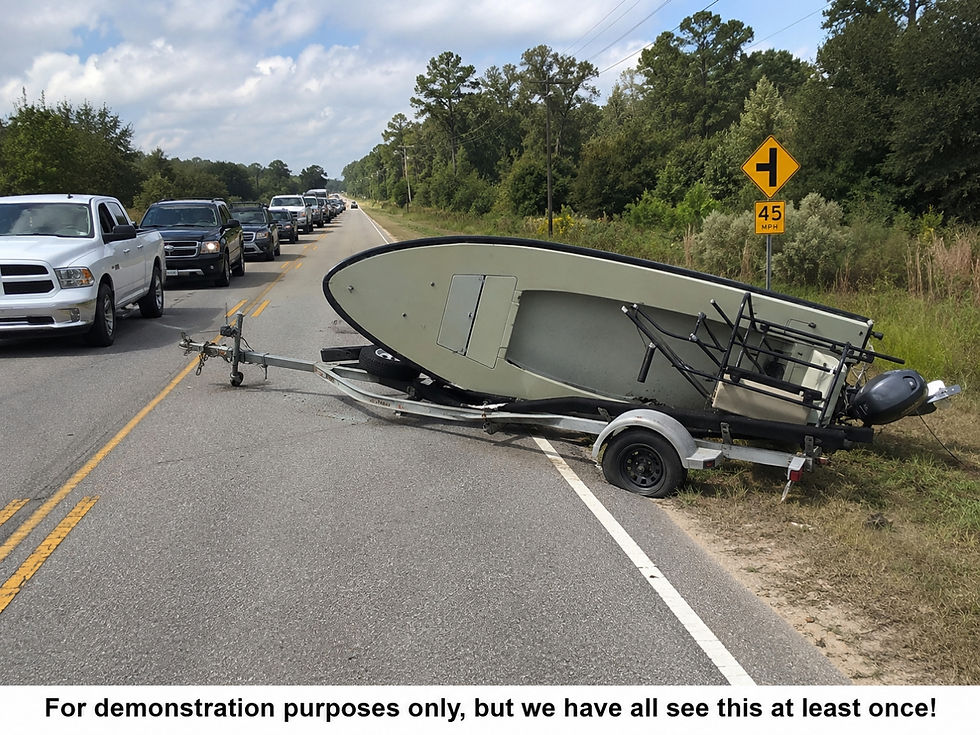
Or maybe it is time for a new trailer before you get to this point. Custom builds from 15 to 45 feet long, our friends at Amera Trail Trailers can help and let them know that Flats Nation sent you!

8. Drive smoother:
DOE says aggressive driving can reduce highway fuel economy by 15% to 30% and city mileage by 10% to 40%. The smoother you accelerate and decelerate, the better your gas mileage. By driving more smoothly, versus consumers who drive erratically can pocket the equivalent of 48 cents a gallon. Driving your truck as if it were pulling the boat all the time and the extra space you allow to speed up and slow down helps.
Pay attention to don't walk signs flashing as you near the next intersection. Most flash ten times before the light changes to yellow. If flashing, and you are too far to make the light safely, then consider coasting... This saves not only on fuel but, also on brake pad wear and extends their replacement intervals simultaneously.
9. Don't idle:
Turn off the engine if stopped off the road for more than 90 seconds if possible. For every two minutes that you don't idle, you'll save the equivalent of nearly 1 cent per gallon (it all adds up). I also do not start mine when I first get into it. I take down the sunshade, lower the windows, and put on my driving glasses and seat belt long before I start the engine. The only thing I don't do before starting, is crank up the Tunes or Soundcheck the next Flats Nation Podcast. This way I at least give the engine a few seconds to turn the oil over, before driving away as I fire up the sonic vibes...
I also do not hammer on the gas pedal for the first few minutes or so for the same reason... I like the engine to get to FOT (Full Operating Temp) if possible, before I do any serious snapping it around. When shutting down, I turn the engine off first, then (without opening any doors) I put up the windows and do other needed items. I often see people leave the engine running while doing such when in most cases, really not needed.
10. Run quality fuel:
Track how your engines (both automotive and outboard) are using it at each tank fill. I posted some Excel sheets that you can download and use. They can track Truck and Boat engine fuel usage under various conditions... After a while, you will better understand which fuels perform the best in (your) engine. Just remember, that burning "more" of a lower quality and/or lower octane fuel than what your engine needs for those conditions, is of no savings and may actually cost you more in the long run.
Those sheets are also an excellent way to track maintenance and service work in the comments sections simultaneously. Having and presenting such records can also help increase your asking price and value at resale time!

For the Skiff or Bay Boat: Less GPH on the Water:
1. If you don't already have one, install a fuel burn gauge/readout for your Outboard:
These will demonstrate the most effective way to trim for lower GPH rates! Consider this in your upgrade path, as it will provide an excellent ROI (Return on Investment) when installed either individually or as part of a planned gauge upgrade package.

2. Never drive a Boat where you can drag it:
No matter how much fuel your tow unit uses, it’s usually way less than what your Skiff or Bay Boat would burn for the same distance. Plan your trip to the closest ramp near your fishing spots and launch from there. This way, you can enjoy the A/C a bit longer and stay out of the weather until it's time to "Pick a fight" with one of these Monsters below... You're going to need all the energy you can get! 😎

3. Power Is Your Pal and Trim Is Your Friend:
This was an insightful tip and operational advice from one of my former Flight Instructors, and it applies equally to your boat. Get the Skiff or Boat up on a Plane swiftly to minimize drag, and then promptly reduce the power once on plane achieved.
Sea states are going to dictate the best running angle of attack, but keeping as much of the hull out of the water as safely possible helps the engine work less to keep it there. Keep an eye on the fuel burn gauge as you make changes, and in short order, the cost of adding that gauge — if you do not already have one — can return those dollars spent and increase fuel savings going forward.

Engine maintenance, checking props, keeping the hull clean, installing a fuel flow meter, watching tides/winds, reducing onboard weight, and using trim tabs/power trim carefully to reduce drag and plane at lower RPM all help.
Hopefully, these tips will help you save money on the Truck fuel tank. Use those savings for the Skiff—it's much more fun to pilot anyway! Also see our other related Flats Nation trailer and skiff maintenance articles. 😊
All part of the first rule in making money: don't spend it...
More from Flats Nation:
Looking for more boating, maintenance, fishing, gear, and coastal lifestyle content? Explore the latest Flats Nation Articles and Podcasts, or stop by the Flats Nation Store for performance wear and gear built for life on and off the water.

Tight Lines, and God Bless!
Dave and the Team


