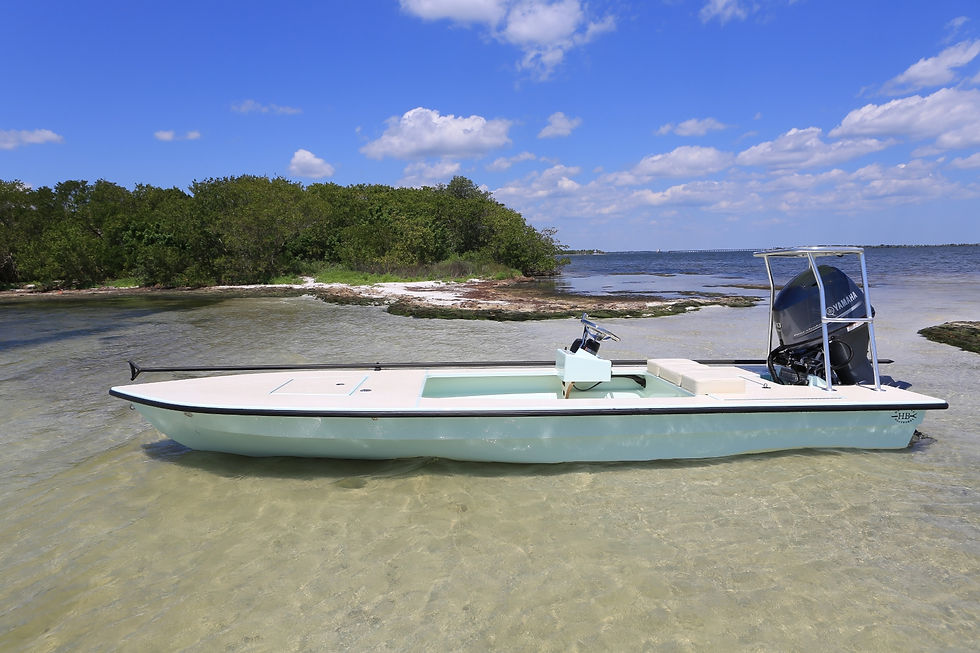
Hell’s Bay Marathon: The Technical Skiff Built to Run

Sometimes the fish you want to reach are a long way from the ramp — and the water between here and there doesn't particularly care that you're running a flats skiff.
That pretty well explains where the Hell’s Bay Marathon fits into the technical-skiff world.

At 17 feet 8 inches, the Marathon is still very much a technical flats skiff. It can be poled, sight-fished, worked down mangrove shorelines and slipped into the kind of shallow water where redfish, snook, permit and tarpon tend to make people forget what time they were supposed to be home.

Built for the Water Between You and the Fish:
There are plenty of technical skiffs that are happiest once they reach protected water.
The Marathon is different because its design pays just as much attention to what happens before you get there.
Its sharper forward entry, integrated spray rails and approximately 12-degree deadrise help the hull handle open water and chop while still retaining the shallow-water fishability expected from a Hell’s Bay.
Anyone who has spent enough time fishing the Panhandle, Tampa Bay, Charlotte Harbor, Florida Bay, the Keys or similar coastal environments knows how quickly conditions can change. A calm morning run can become a considerably different trip home once an afternoon sea breeze starts stacking things up!
That distinction matters:
The Marathon was built with that reality in mind.
t has enough bow to work through rougher conditions, enough running surface aft to remain efficient and stable, and enough technical-skiff DNA that when you finally reach the shoreline, flat or backcountry water you came to fish, the boat can settle down and get back to business.
In other words, the Marathon is still a technical skiff when the push pole comes down. It just happens to be one that doesn't mind earning a few miles before it gets there.
A Different Kind of Technical Skiff:
The Marathon should not simply be thought of as a smaller Marquesa or another variation of the Professional. In fact, its development owes a great deal to the Biscayne — essentially carrying much of that hull’s rough-water DNA into a stretched technical-skiff platform.

Each Hell’s Bay hull has its own intended mission.
The Waterman is the no-frills, fishing-first workhorse.
The Professional has long represented the classic Hell’s Bay technical poling-skiff formula.
The Marquesa adds considerably more room and big-water capability while still maintaining its shallow-water roots.
The Marathon lands somewhere different — carrying much of the Biscayne’s rough-water influence into a compact technical-skiff platform built to cover distance and still fish shallow when it gets there.
It retains a relatively narrow 73-inch beam and a manageable 17-foot-8-inch overall length, but places greater emphasis on ride and open-water performance than you might expect from a technical skiff of this size.
That combination makes it particularly interesting for anglers who do not necessarily need a larger skiff but still have to travel through less-than-perfect water to reach their fishing grounds. The Marathon was also developed with speed and the tarpon-tournament angler very much in mind.

It is the difference between designing a skiff only around where you fish and designing one around the entire day.
Plenty of Fishing Room for a Skiff Under 18 Feet:
One of the more noticeable features of the Marathon is the amount of usable fishing space packed into the hull.
The large forward casting deck provides plenty of working room for sight-fishing, stripping fly line or moving with a fish as it changes direction. The relatively open cockpit also keeps the boat from feeling overly busy or cluttered.

And that matters on any technical skiff — especially one designed with tournament fishing in mind.
Fly anglers in particular already bring enough loose line, leaders, stripping baskets, fly boxes and other assorted opportunities to step on something expensive.
The last thing we need is the boat helping us out. 😁
Under-gunwale rod storage helps keep rods protected and out of the way, while the aft deck provides storage, seating and livewell capability without consuming the entire cockpit.
As with most Hell’s Bay skiffs, the Marathon can also be configured considerably beyond its standard equipment depending on how the owner intends to fish.
A trolling motor, elevated casting platform, hydraulic jack plate, upgraded electronics and various poling-platform configurations are among the options commonly seen on Marathon builds.

The important distinction is that those are options and individual rigging choices, rather than what defines the basic Marathon hull.
Built for the Run and the Push Pole:
One of the recurring balancing acts in technical-skiff design is simple to describe and considerably harder to accomplish:
Build something that runs well without turning it into a heavy boat that becomes miserable to pole.
The Marathon weighs approximately 650 pounds before engine and equipment, which keeps it well within true technical-skiff territory while allowing the hull to carry more deadrise and open-water capability.

Once the boat reaches the fishing grounds, its relatively narrow beam becomes important again.
A narrower technical skiff generally presents less hull to move through the water while poling, and the Marathon maintains the kind of clean deck and poling-platform arrangement expected of a dedicated shallow-water boat.
That dual-purpose character is really the heart of the Marathon.
Throttle down, trim it out and cover the miles.
Then shut everything down, grab the push pole and start hunting.

That is where the Marathon really earns its keep.
Construction and Materials:
Like the other current Hell’s Bay technical skiffs we have covered here on Flats Nation, the Marathon uses some serious materials underneath all that shiny gelcoat.
Current construction includes:
Vacuum-infused Core Cell™ throughout the structure
Carbon-fiber stringer system
100% vinyl ester resin
Integrated spray rails
Heavy-duty rub rail
Quiet and dry gasketed hatches
Hydraulic steering
Electric trim tabs
Under-gunwale rod storage
Plumbed livewell
Automatic bilge pump
Anodized aluminum poling platform
Hell’s Bay also states that its current construction meets ISO 12215-5 industry standards.
That combination of composite materials is one of the reasons Hell’s Bay can produce a hull like the Marathon with enough structure for rougher running while keeping the overall weight appropriate for a technical poling skiff.
Carbon Innegra, Core Cell, vinyl ester resin and vacuum infusion may sound like something requiring a lab coat, but the objective is pretty old-school:
Build it strong without building it unnecessarily heavy.
Hell’s Bay Marathon Specs:
Here are the current basic specifications for the Marathon:
Length: 17' 8"
Beam: 73"
Hull Weight: Approximately 650 lbs.
Draft: Approximately 9"
Recommended Power: 70–115 HP
Fuel Capacity: 28 gallons
Those numbers tell an interesting story when viewed together.
The Marathon is shorter than many flats boats used for open-water running, yet carries a substantial fuel capacity for its size. The 70–115 HP range also allows the boat to be configured differently depending on whether an owner places greater emphasis on overall weight, efficiency or higher-end performance.
For the long-run fisherman, that 28-gallon fuel capacity may be one of the more important numbers on the list.

One of the useful things about looking at real-world Marathon builds is seeing how owners actually configure the boat once it leaves the factory.
Depending on the intended use, a Marathon may be equipped with items such as a hydraulic jack plate, trolling motor, lithium battery system, upgraded electronics or an elevated casting platform.
Those choices can vary considerably from one boat to another, which is exactly why the factory hull and its intended mission matter more than any one individual equipment list.
The Marathon’s Sweet Spot:

This may be the most important question for anyone comparing Hell’s Bay models.
Why choose the Marathon?
The answer really comes down to where you fish and what you have to cross to get there.
If ultra-shallow draft and simplicity are the overriding priorities, another model in the Hell’s Bay lineup may make more sense.
If considerably more space, passenger capacity and big-water presence are required, the Marquesa starts making a strong argument for itself.
The Marathon's sweet spot is the angler who wants a legitimate technical skiff but regularly encounters open bays, wind chop and longer runs as part of the fishing day.
Think Keys runs.
Florida Bay.
Tampa Bay (what a washing machine that water can become)
Long stretches of exposed shoreline.
Tarpon fishing where today’s fish somehow always seem to be several miles from where yesterday’s fish were — especially when tournament time means you need enough speed to get there before somebody else does.
Sound familiar?

The Marathon gives that angler a smaller technical platform without pretending every fishing day begins and ends behind a protected mangrove island.
And Then There is the Trailer:
One change worth mentioning since some older Marathon examples were built is Hell’s Bay's move to Amera Trail Trailers for its current OEM trailer packages. Current Hell’s Bay skiffs are paired with custom aluminum trailers designed around the individual hull.
That may sound like a secondary consideration until you spend enough years launching, retrieving and towing boats. Then you learn the trailer is part of the boat.
A properly fitted trailer supports the hull correctly, loads more predictably and makes the trip to and from the ramp considerably less adventurous — because the fishing itself should provide enough adventure for one day.
Final Thoughts:
The Hell’s Bay Marathon occupies an interesting piece of real estate in the technical-skiff market.
It is not trying to be the absolute lightest skiff on the flat, and it is not trying to become a bay boat. It does not need to be either one.
Instead, the Marathon addresses something many serious shallow-water anglers eventually discover: sometimes reaching skinny water requires crossing some decidedly un-skinny water first.
That is where this boat makes sense.
The sharper entry, additional deadrise, integrated spray rails and compact dimensions all work toward giving the angler a skiff capable of covering open water while still retaining the stealth, layout and fishability needed once the real hunt begins.

For someone whose fishing regularly involves long runs, changing weather, open bays and technical sight-fishing all in the same day, the Marathon may represent one of the more interesting compromises in the Hell’s Bay lineup. And compromise is not necessarily a bad word.
Sometimes it just means having the right tool for both sides of the trip.
Big shoutout to our friend Captain (Brother) Brett Martina for several of the pictures used in this article. Brett was also one of the original captains who had direct input into the design and development of the Hell’s Bay Marathon — so his connection to this skiff goes well beyond simply running one.


Big thanks to our friends over at Hell’s Bay Boatworks. If you're interested in learning more about the Marathon — or any of the other Hell’s Bay skiffs for your particular fishing use case — check out their current lineup and let Sales know that Dave from Flats Nation sent you.
More from Flats Nation:
Looking for more boating, maintenance, fishing, gear, and coastal lifestyle content? Explore the latest Flats Nation Articles and Podcasts, or stop by the Flats Nation Store for performance wear and gear built for life on and off the water.

So, do like, and share Flats Nation with family and friends if you would 😎
Tight Lines, and God Bless!
Dave and the Team