


What Makes a Flats Skiff a Flats Skiff?


Every now and then, I get the opportunity to wear a couple of different hats in the marine industry.
Along with writing and producing the content you see here on Flats Nation, I also do Website, SEO, and content work for a number of companies within the Flats Fishing ecosystem. Hell’s Bay Boatworks is one of them, and like many of the articles you may have seen on their website, I wrote a recent piece that tackles a question that sounds simple at first:
What exactly is a flats skiff?
For those of us who have spent years around shallow-water boats, the answer may seem obvious. But the term “flats skiff” gets thrown around pretty loosely these days.
A shallow-draft boat is not automatically a technical flats skiff.
A bay boat that can sneak into relatively skinny water isn't necessarily a flats skiff either.
Slapping a poling platform on the back of something doesn’t exactly end the debate, does it? 😉 I’ve seen setups that are like trying to pole around the USS Alabama—good luck lasting more than a hot minute in that 90-degree sauna!
It Comes Back to the Mission:

A true flats skiff is a purpose-built shallow-water fishing platform.
Draft matters, of course, but there is much more to the equation.
Stealth matters.
Weight matters.
Hull design matters.
Poling efficiency matters.
The amount of water displaced while quietly approaching a fish matters.
And perhaps most importantly, the entire boat should be designed around helping an angler get into shallow water, quietly position the boat, see the fish, and make the cast.
That's considerably different from simply building a small boat that happens to float shallow.
The article I recently put together for our friends at Hell’s Bay Boatworks digs deeper into those differences, including what flats skiffs are used for, how shallow they can operate, their limitations when conditions get rough, and even the sometimes-fuzzy distinction between the terms “flats boat” and “flats skiff.”

The Boat Is Only Half of the Package:
There is another part of the equation that doesn't always get enough attention — what is underneath the skiff when it isn't in the water.
The trailer.
That connection is especially appropriate here because Amera Trail is now the OEM trailer manufacturer for Hell’s Bay Boatworks, building trailers engineered around the hulls they are carrying.
If you've followed Flats Nation for a while, you already know Amera Trail as one of our collaborators — and a company we've spent quite a bit of time around.
With a technical skiff, getting the trailer geometry right is particularly important. Hull support, bunk placement, launch depth, overall ride height, access at marginal ramps, and the ability to launch and retrieve the boat efficiently all become part of the total package.
After all, there isn't much benefit in owning a skiff designed to reach places other boats can't if getting the thing off the trailer requires a municipal boat ramp, three feet of water, and an act of Congress. 😁
We previously took a much closer look at the Hell’s Bay/Amera Trail combination here on Flats Nation.
A Good Fishing-Radio Question Too...
This entire subject also gives me something fun to throw into the mix on a Saturday or Sunday morning.
If you're up early, Capt. Mike Anderson hosts Reel Animals Saturday on News Radio 970 WFLA from 6–8 a.m, and we plan on calling into the show and kicking around this very subject soon:
What really separates a true flats skiff from all the other shallow-water boats being called “flats boats” today?
Mike has spent decades fishing Florida's inshore waters, so I suspect he may have an opinion or two on that one.
Imagine that. 😎
It's also a good question for the rest of The Nation:
What is the one characteristic you think a boat absolutely has to possess before you would call it a true flats skiff?
Shallow draft?
Ability to pole efficiently?
Low hull slap? (Very important, in my opinion. I've had some that would make it hard to sneak up on a deaf bird dog in a chop.🙄)
Lightweight construction?
Clean casting decks?
Or is it the complete combination?
Drop us your thoughts.
Because while materials, construction techniques, engines, electronics, and even trailers continue to evolve, the basic purpose of the flats skiff hasn't changed very much.
Get in skinny. Stay quiet. Find the fish. Make the cast.
And hopefully have a good trailer waiting for you when you get back to the ramp.

Enjoying Flats Nation? Help Keep The Nation on the Water:
If you enjoy the articles, podcasts, photography, and other related content we put together here at Flats Nation, you can help keep it all moving by visiting our Store.
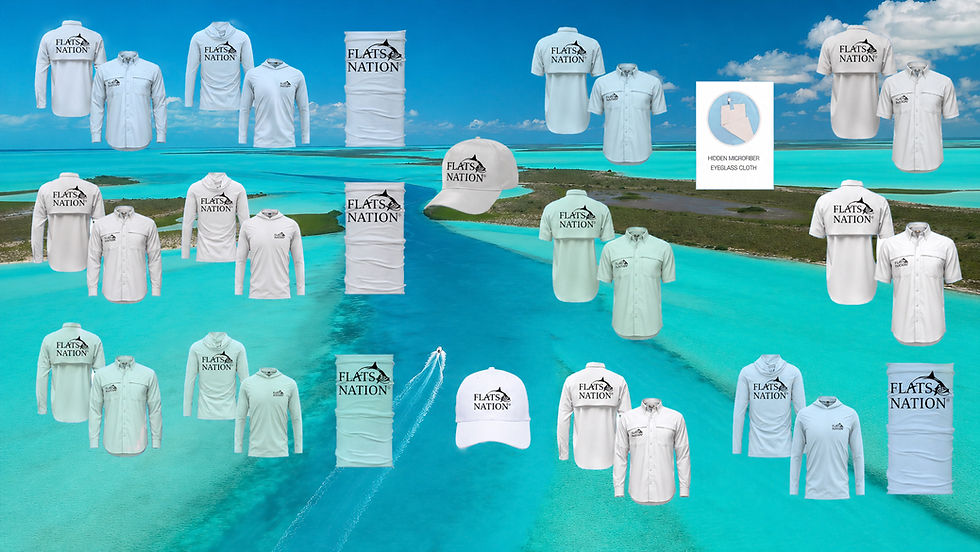
Every shirt, hat, decal, or other piece of Flats Nation gear helps support the work behind The Nation — while giving you something pretty cool to take along for the ride.
Grab some gear, represent The Nation, and help us keep bringing you more from the water.
Tight Lines and God Bless!
Dave and the Team


